


As more companies switch to electric vehicles, home charging has become part of everyday operations. That brings a new question for employers: how do you reimburse employees fairly and efficiently for the electricity they use to charge their company car at home?
Split billing offers a clear answer. In this article, we explain what split billing is, why it matters, and how you can apply it in practice with Mobiflow.
What is split billing?
Split billing is a smart way to separate the electricity used for charging a company car at home from an employee’s regular household energy consumption.
Normally, home charging is paid by the employee via their energy bill. The employer then reimburses those costs, often based on manual declarations, estimates, or fixed allowances. That process is time-consuming, prone to errors, and increasingly difficult to justify from a tax and compliance perspective.
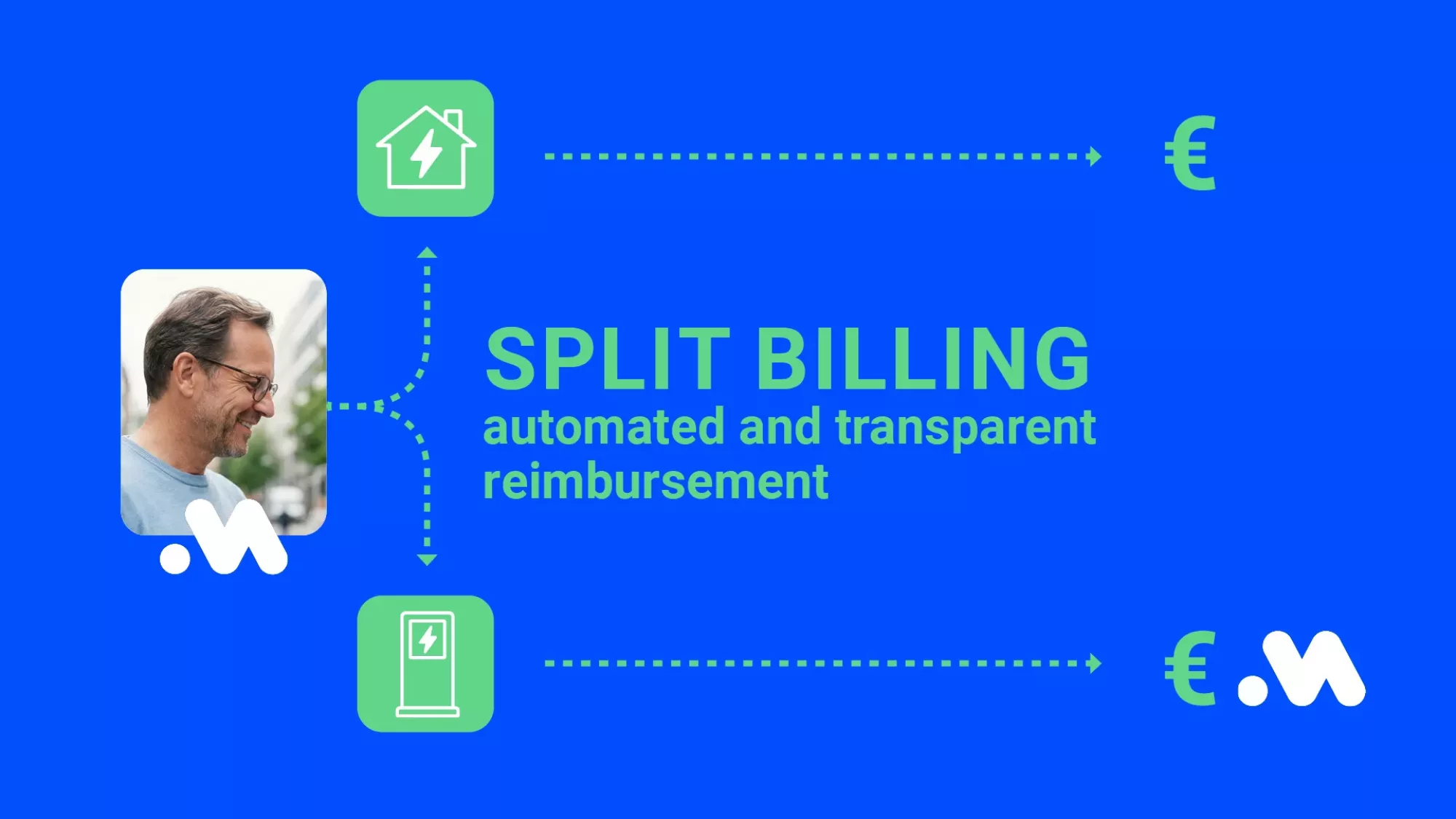
With split billing, this changes. Charging sessions for the company car are identified and recorded separately from the rest of the household’s electricity use. Those charging costs are then invoiced directly to the employer, while the employee continues to pay their own household energy bill as usual.
In short:
- household consumption stays with the employee
- charging the company car is billed to the employer
- reimbursement is automated and transparent
Split billing typically works via a smart charging cable or charging station that sends charging data to a central platform, such as Mobiflow. That platform handles the registration, calculation, and reimbursement of charging costs.
Why split billing makes sense for employers
Split billing is not just a technical solution. It solves several real-world challenges that employers face today.
1. Less administrative work
Without split billing, home charging reimbursement often relies on Excel files, manual declarations, or complex calculations. Split billing automates the entire flow, from charging session to reimbursement. That saves time for HR, fleet managers, and finance teams.
2. More transparency and control
Split billing gives employers clear insight into:
- when charging sessions take place
- how much energy is used
- how much is reimbursed per employee
All data is centrally available and traceable, making internal reporting and audits much easier.
3. Tax and compliance alignment
In Belgium, reimbursement for home charging must be defensible and consistent with tax rules. Using official reference tariffs, such as the CREG electricity rate, helps employers stay compliant.
Split billing platforms automatically apply an agreed electricity rate, such as the CREG tariff, to every home charging session, so reimbursements are calculated in a consistent and defensible way.
4. A better experience for employees
Employees no longer need to submit expense claims or worry about whether their reimbursement is correct. Once split billing is activated, reimbursement happens automatically, based on actual charging data.
How does split billing work with Mobiflow?
Mobiflow provides a structured way to apply split billing, from setup to reimbursement. The process is straightforward and scalable.
Step 1: Set up split billing–compatible charging
Split billing requires a compatible charging solution, either a compatible charging station or an intelligent charging cable. This hardware registers each charging session and sends the data securely to the Mobiflow platform. Mobiflow is compatible with most popular hardware from vendors such as Alfen, Smappee, Easee, Schneider, ABB, Wallbox,…
Step 2: Create a split billing contract
As an employer, you create a split billing contract in the Mobiflow environment. This contract connects the employee with the charging point and the reimbursement conditions.
You also select the commercial conditions for the contract, such as the monthly service fee per charging point.
Step 3: Define a reimbursement policy
Next, you define a reimbursement policy. This policy determines how much the employer reimburses per kWh.
You can choose:
- a fixed self-selected rate, or
- the official CREG tariff, which is regularly updated and commonly used as a compliant reference
Once created, the reimbursement policy is linked to the split billing contract.
Step 4: Activate and connect the employee
The employee receives an invitation to connect their home charging setup to the split billing contract. Activation happens through a guided flow, either via an existing Mobiflow account or via a simple email-based setup for employees who are new to Mobiflow.
After activation, Mobiflow starts registering charging sessions automatically.
Step 5: Automated reimbursement
From that moment on:
- charging sessions are recorded
- reimbursement amounts are calculated
- invoices or payment requests are generated for the employer
Employees are reimbursed according to the agreed policy, without manual intervention.
A few practical tips for employers
- Start with the CREG tariff
Using an official reference rate reduces complexity and provides a solid compliance baseline. - Make sure you have the employee’s personal email address
This is required to activate split billing and link reimbursement to the right employee. - Communicate clearly
Explain to employees how split billing works and what changes for them. Most will welcome the simplicity. - Add a payment method for a fully automated flow
By adding a payment method in Mobiflow, reimbursements and invoices can be processed automatically, reducing follow-up and keeping the entire split billing process smooth.
A simpler way to reimburse home charging
Split billing is a practical solution for employers who want to reimburse home charging in a fair, transparent, and compliant way. By separating household electricity from company car charging, it eliminates manual work and uncertainty.
With Mobiflow, employers can set up split billing in a structured way, from contract creation to automated reimbursement, and support the growing shift toward electric mobility without adding administrative burden.